Showing posts with label compromise. Show all posts

Friday, June 21, 2013

Ditching

I am sitting at work today and receiving hourly text messages about my son's unexcused absences. Oops, he missed first period. Darn it, 2nd and 3rd he's nowhere to be found either! Truth be told, I stopped checking my phone, knowing that he wasn't running late. He was ditching.

In an unexpected turn of events, I gave him permission to ditch. My husband gave a very formal and clear commentary about his reservations, but ultimately agreed. Yes, son, you have our blessing to ignore the rules and go to the beach instead. The reason I caved so easily is simple. It's the end of the year and evidently instruction of any kind is no longer necessary. Our son has spent the last week watching movies in his classes. He finished his finals and brings a healthy pile of books to read, not Shakespeare or a literary classic, but World War Z or a David Sedaris collection.

When I was a kid...(can you just picture the eye rolling) we worked up until the last day, finishing off every possible workbook page, catching up on art activities or creative writing assignments. We did spend more time outside in recess and gym but I never once remember watching a movie, let alone in multiple classes. We set aside a part of each day in that last week to clean our classrooms. Monday might be the washing of all the desks, Tuesday return textbooks to storage, Wednesday thoroughly wash the boards and sweep the floor, Thursday remove all papers and projects from the classroom and take them home, Friday hang out and relax and see our teacher as a pretty nice person overall, while daydreaming about swimming and street carnivals. 

The last week of school, for me, was fun. We got to be more creative, more physical, and more interactive than we'd been allowed the whole rest of the year. We were excited for summer and for being done, and we were relieved to learn our subjects without a grade attached.  

Instead, my son's teachers are cleaning their classrooms by themselves. Since no more grades will be given there seems to be no need for learning.  Practicing what they've already learned and integrating it into their life when the standardized tests are completed, appears pointless. Why bother taking up frivolous pursuits like relay races, jam sessions, or fun trivia games?  Is it really possible that on a certain day in June, everything there is to know about creative writing, jazz, physics, or Spanish was mastered so fully that there was just nothing left to do?  Have we trained our kids to only want to learn if a grade, an assessment from outside of themselves is given? Yikes!  

When my son said he wanted to ditch his last day and go to the beach instead, I said "yes". For one, how could I not reward such an honest kid with such a great argument? Secondly, I figured a cardio workout on his bike coupled with an "in the field" exploration of the natural environs of the Great Lakes was more productive and educational. 

Tuesday, November 13, 2012

Humility - Is it Possible Anymore?

020/365 united we stand...
020/365 united we stand... (Photo credit: Joits)
There's been a big pause since my last post.  It's been a busy time for me at my job and quite honestly,  I  wasn't sure what to write about the election. It was the only thing on my mind for awhile but I didn't know how to talk about it here. Now that the ballots are counted though, I do have two thoughts that keep swirling in my head - humility and concern.

Obama and Romney were in a near tie for the popular vote.  Even in the most Republican or most Democrat controlled outposts there was still a respectable contingent voting for the opposing party. (Yes, Virginia, there are Republicans in Chicago.) In theory, whomever wins an election will be making decisions based on the needs of people who voted for and against them. Our leaders may get financed by a specific party but when they arrive in office they are the public servant for everyone. Right?  That's what we say.

Public service to a whole country or state requires genuine concern. True public servants ask questions about what the people need.  The concern, if pursued, demands humility, the deep understanding that none of us knows it all. Is humility possible anymore? Humility requires that we listen to the experiences of others to better inform our limited experiences. 

I've always lived in urban areas and in my circle of friends, growing up, were people who had been injured on their jobs in the Gary steel mills.  Government controls like the Environmental Protection Agency or OSHA (Occupational Safety and Health Administration) were just "givens" in my mind.  Everything those agencies did was necessary and important and valued, in my experience.  I was taken aback when I visited rural New York and talked with folks who were small business owners.  They were struggling to absorb the expensive testing and safe disposal fees for their auto body shop.  The same laws that protected one set of my friends were bankrupting others.  I still felt that workplace safety was important but now I better understood the financial impact of those policies and how the issues were so much more complicated.
I hear alot about the need to cut the deficit and have family members who are frustrated about the amount of government supports for the poor. In my own job however, I work with an organization serving the homeless.  I know that ignoring the needs of the poor, regardless of your value system, is expensive to society.  Homeless prevention funding has been reduced dramatically and yet $3,000 in prevention costs, money that keeps a family from ever becoming homeless, can save the community up to $50,000.  Cutting the budget in the area of social services often means more people incurring expensive emergency room care, police costs, and prison expenses for the taxpayers.

The issues are always like this - complex, nuanced, and not served very well by hyperbole and name calling.
The time for sound bites is over for now.  We need to move our conversations to a more productive and less condemning place.  With a little bit of humility and the willingness to listen to another's perspective, we might just have a chance to talk about solutions instead of blame. We might be able to improve our problems a small fraction instead of worrying about being 100% "right".  We need to practice that lost art of conversation and teach the kids in our life about it as well.  If we do, maybe we'll raise a few future public servants that actually know how to think about all of us.
Enhanced by Zemanta

Thursday, May 31, 2012

Space and Sharing

My post, Attachment Parenting, left me going down memory lane a bit.  I realized, as I looked back, that our early decisions to practice attachment parenting extended to many more intentional decisions even as our kids started to grow up.  Shared space in the form of a sling or a bed turned into a shared bedroom, shared toys, one family computer, and one television.  Interestingly enough, these very simple choices sometimes felt just as counter cultural as having a home birth.

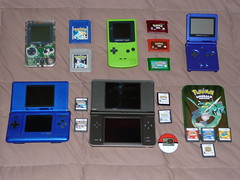
For Christmas one year we made the earth shattering decision  to purchase a Game Boy for the boys.  It felt like a life changing moment for our family.  Choosing to buy only one and have both boys share it was our way of keeping our little team in balance.  I remember the day after Christmas when they told their friends what they had gotten.  I felt a twinge of guilt for not giving them each their own and then I heard my son say, "It's ok, cuz I'm good at the jumps and he's good at finding the treasures.  So we are going fast through the levels."

Pokemon and Game Boy of the past.
Pokemon and Game Boy of the past. (Photo credit: heath_bar)
Those stupid video games had them going to the store and negotiating which new game they would purchase, returning to trade old, conquered ones for a new challenge.  They needed to come to consensus on each acquisition or spend 100% of their own money on a game that they could only play when the other person was otherwise occupied. Even with our imposed limits they managed to be obsessed by the images on the four inch screen.  We were far from Amish and yet I still felt like I was out of the normal range of accepted U.S. parenting practices.  I felt out of sync because I was resisting the consumption driven culture.  How dare I not purchase as much as possible for my children.  How dare I make them wait for the latest game until they could buy it for themselves or find it used or for trade, 6 months later.

We bought the Game Boy because we wanted to do something special for our children. We wanted to indulge one of their kiddie desires. We minimized how much it could control our lives by insisting that our sons shared it and by limiting when they could use it - 10 hour car rides to South Dakota -YES!; parties at friends' homes - NO!  We aren't carrying them in a sling anymore but we are still trying to find ways that we can share space and stuff as a family.

It changes over time but there is always something, at every developmental age, that ends up forcing us to decide what is right for our family.  Now, there are nights when we are all within 10 feet of each other but on a different screen -, tv, computer, ipod.  I'm grateful that we decided to have the screens only on the first level of our house and I'm grateful that we have one tv that requires us to negotiate/talk/argue. Now that we have teenagers it feels like we are starting to reap the benefits of our families' counter cultural revolution.  I'm glad that we are still attached and sharing space.
Enhanced by Zemanta

Monday, May 7, 2012

Turning Points - uno

I was thinking yesterday about pivotal moments in our family.  We had dinner with some new friends and the getting to know you conversation turned to children.  Theirs are grown and as we spoke they kept reflecting on their own memories.  I was touched when the father started talking about the trip he had taken to Paris with his daughter to celebrate her 40th birthday.  "I wanted to do something special with each of my children when they hit that age.  Something that they would remember.", he said.  He's planning an Alaska trip with his second daughter for next year, on her 40th. 

His story helped me relax a little and note that there will be a lifetime of opportunities to develop, teach, share, love, and nurture.  I don't have to squeeze it all in by the age of 18.  So many times I've thought that maybe one certain moment is the one that's going to make the difference, for good or bad.  I was convinced that on the day that I let my youngest son quit piano lessons, I was securing his place in a life of hardship.  I thought for sure that this had the power to create a life habit of giving up when things got hard, which would then lead to poor academics and hanging out instead, which of course would lead to him becoming an immediate gratification junkie or maybe just a drug addict in general.  He was 9.
Music guitar
Music guitar (Photo credit: @Doug88888)

He's 13 now and I've been listening to him play his guitar for the last hour or more, for pleasure.  Letting go of the piano was a turning point for him.  It was one of the first times that he asserted himself and articulated what he did or didn't want on anything of real importance.  It was also a turning point for me as a parent.  It was one of the first times that I had to figure out what the real issue was and articulate what the family values were that I was protecting.  We came to the realization that it wasn't piano that was important but rather having some type of arts training, something that wasn't available in their school at all.  I let him choose what would come next - dance?, guitar?, painting?  He chose guitar.  He's still had moments where he wanted to quit guitar but they have been moments of frustration, wishing that he could master a certain skill that's still out of reach.

I wonder where he would be with music now if I had dug in my heels and insisted on having him "hang in there".  I wonder how I would be feeling now if I had insisted that pressuring a 9 yr old into "my plan" was the most important, make or break parenting decision I was going to make.  These turning points are not moments where we make the "right" or "wrong" decisions but rather places where we turn, move, evolve.  There will be more chances to correct or improve on what we've chosen - long after they are 9 or 13 or 18 or 40.
Enhanced by Zemanta

Tuesday, April 17, 2012

Because I Said So

A game of tug of war
A game of tug of war (Photo credit: Wikipedia)
We've all had those moments when our child wants one thing, we want a different or the very opposite thing and as a result, become locked into a back and forth tennis match of opinion, then debate, then argument, then emotional meltdown. They're the ones where the phrase from childhood comes close to the surface.  You know the one, "Because I said so!"  We had one of those recently in our home and it raised a whole other question for me.  When or how do we allow our children to have their own ideas and opinions and still have parental authority?  Who gets to make the final decision on home issues when there are competing wants or needs?  I work pretty hard to give my kids opportunities to practice their own problem solving.  Communicating their feelings and the desires that come from those feelings is a good thing to me.  Being challenged to let go of something I want starts to feel more difficult.

I'm trying to create a home where children can figure out who they are as an individual AND be a respectful part of the family collective.  So what do we do when it feels like there can only be one way and someone is about to feel disregarded?  It can be simple stuff, one person is hot and wants the thermostat set low, the other is cold all the time and wants to crank the heat.  Other differences are much more significant and can end up feeling like a personal attack or rejection.  Our child's wardrobe, hairstyles, and choices of friends are all areas where child and parent  both feel like they should be able to weigh in and assert their opinion.  As much as I strive to let my guys make their own choices, there are plenty of moments where I pull them back with a tone of, "Try again, I'm not okay with that."  (Most of these conversations seem to happen as my youngest is walking out the door for school.)  Whenever possible, I try to let them be in control of their own choices.  I do that because I know there are going to be just as many times when they will have to defer to their parents or teachers.  There are an awful lot of "Because I said so." interactions for our kids.  It can be easier for them to swallow those if we let their interests and priorities win out sometimes too.
Enhanced by Zemanta

Tuesday, March 13, 2012

Touching Base

There was a time when I felt I was being "touched out".  Little sleep at night, nursing, carrying one baby in the sling while the two year old climbed my lap, vying for attention, had me a titch tapped.  My two year old had come upon the perfect solution to grabbing some mommy time, even if I was busy with his baby brother. He would sit or stand next to me and lay the palm of his hand on my cheek.  He would do this as I was sitting and talking to a friend, feeding his brother, or on the phone.  It was like his compromise stance that said, "I know I'm not the baby anymore but I need to know that you're here for me".

Both boys followed the developmental game of hide and seek when they were toddlers.  Basically, the game goes like this: Child runs away and plays/gets into trouble/wanders the house and then runs back after about 20-30 minutes, to make sure that you are still where they left you.  They want to be a "big kid" and separate from us but when they do it gets a little scary. They need to check in and confirm that we're still with them even when they can't see us.

The little boys are gone and young men are emerging in their place.  A new, revised version of the hide and seek game has also emerged.  It's 10x more important for my teen guys to learn how to be independent and they have all kinds of things where they need to be assertive and distinguish themselves as their own person.  Just like the original version of hide and seek though, every once in awhile they have to pop back in and make sure that we're still there for them.  The twist on the game is that sometimes we have to be the ones to figure out that they want us to come seeking. 

Now it's us as the parents, negotiating a cool way to check in with our teens and remind them that we are here for them. My young men  aren't sure what a kiss goodnight or a hug from their mom and (God forbid) dad will mean for their manhood.  We don't have a long bedtime routine anymore where we read books and talk about the day.  Instead we are in the process of discovering new compromise moves that allow us to touch base.  My husband has this very long and complicated fist bump sequence that has replaced any hugs or kisses.  I will frequently use goofy voices and surprise bear hugs to get a little love from my youngest.  Tender and caring gestures traded out for rough housing and slapstick.  When they were little and I felt completely touched out, I always knew that a little hand on my cheek could calm the fears and anxieties.  Now, I have to remind myself that just when they seem to want TLC the least, is when I should sneak up from the left flank and give a big squeeze.

Thursday, March 1, 2012

Asking the "village" - apples and oranges

I started talking about this yesterday but just to remind you - my boys are very different.  They have the same mother and father, born two years apart, live in the same environment and go to the same schools, and yet they are different as apples and oranges.  Per my brief bio, my boys were born at home, so we can rule out some weird mix-up at the hospital.  Whether our kids are with us from birth and share our DNA or whether they come to us as toddlers or teenagers, through adoption or foster care, or whether "our kids" are the neighbors who visit us on a regular basis, they are "our kids" because we love them as they are.  We love the pieces of them that we recognize and the pieces that are bizarre and foreign (my husband is convinced that our one son's early morning rising is perhaps an early warning sign of some strange mutation).

So, if we accept the fact that our kids are going to be unique creatures and not cookie cutters of us, how do we meet the varied needs?  We want to encourage their talents and be sensitive to their concerns but we also want to be sensitive to our desires or those of others in the family.  Take my guys, one is a raging extrovert.  His ideal day would be talking non-stop in a mosh pit of humanity, taking breaks only for food and reading.  My other son can be very social but in his perfect world he is juggling or unicycling for hours, with no more than one other friend. They are both smart, but one thrives on group projects while the other prefers to work alone with focused attention. One lingers on, saying, "goodnight" multiple times and remembering one more story or footnote on the day that needs to be shared.  The other keeps watch of the time himself and can disappear at the bewitching hour without a peep.  If we decide to go to a museum, we have one child who is in heaven, reading material and mingling with people everywhere while the other son is "peopled out" 30 minutes into the outing and begging to do laps around the parking lot instead. How do you engage two (or three or four) divergent personalities in a way that honors everyone?

This was my dilemma last summer.  Our normal vacations involve road trips to visit family members.  For the very first time we took a family vacation that was just our little foursome, planning our days and nights, routes, food, and entertainment for a whole week.  As the planner of vacations I was a little nervous.   I decided that the best way to get "buy in" was if everybody was part of the plan.  I asked everyone what a perfect trip to the Black Hills would include from their perspective. We made a list of all those ideas and made sure that everyone knew their thing would get done and when.   I also told them that if we ever got to a point where we weren't sure what to do next on a given day, everyone could have one wild card choice during the trip.  They could choose to use it during the week if they felt their needs just really needed to be considered most in our decision.  That week we went horseback riding, explored caves (in the dark and in very confined space), toured the Wounded Knee Museum, and took incredibly long and beautiful scenic drives through Custer Park.  We all participated, even though the museum almost bored my youngest son to tears and my husband had a bloody scalp from scraping the ceilings of the caves. 

When the kids were little such idyllic displays of cooperation and enlightened compromise did not exist.  It often felt like a day was not complete unless someone was pouting, crying, or in full blown, red alert mode.  Usually the upset was directly linked to somebody needing to sit outside of their comfort zone for just a titch too long.  I could count on a meltdown when the extrovert was forced to stay home with me all day or the introvert was required to hangout at a church activity AND stay indoors.  I would sit at baseball games for one, watching the game part of the time and part of the time playing catch with the other one who hates team sports but loves being physical.  I ended most days feeling like I had let somebody down.  

Fast forward ten years.  to my oldest son surprising me and  putting all of this in perspective.  He said that while he didn't like it at the time, doing things together as a family helped him.  His insight came when I asked him if he had any idea how he came to be such a cool person (the single most awesome conversation I've had with him).  He shared some interesting thoughts and one was, "I hated having to do everything together but I also think it ended up helping me.  Whether you planned it or not, it was teaching us that "it" isn't always about what we want."  It absolutely wasn't planned but he's right.  The differences in our families allows us to practice cooperation and compromise.  They allow us to set aside our own personal desires once in awhile and think about other people.  They allow us to learn new things and try new things that our own little comfort zone wouldn't have made possible.  It isn't very pretty at times but it's absolutely better than only doing things that we want, when we want them.  Our family is our first little practice run at having classmates, coworkers, and personal relationships.  You know the people in your life who didn't get enough practice as kids.  Differences can be a pain but they can also help us learn how to be great grown ups.